- Jul 11
AI Won't Replace Your Team and it's Too Expensive To Try.
- Francesca Wood
- 0 comments

A lot of hospitality businesses spent the last two years cutting headcount and handing the work to AI. Some of them are now quietly re-hiring, because the AI bill turned out to be bigger than the wage bill it replaced.
That's not a failure of the technology, it's a failure of the plan. Human AI collaboration in hospitality isn't a nice-to-have philosophy for people who feel sentimental about staff. It's the only version of this that's actually affordable, because the free lunch era of AI is over, and it was never really free to begin with.
The problem: businesses bought AI like it was a straight swap for people
The pitch was simple: Replace the reservations team with a chatbot, replace the reporting analyst with an agent, and replace the front office with a screen. Cut the cost line and keep the output.
For a while, that pitch looked true, because AI was priced like a loss leader. Demand for AI products has climbed sharply industry-wide, but that growth has been sitting on top of huge subsidies and the largest capital spend the tech sector has ever committed to.
Hospitality operators who swapped people for AI during that window were comparing a wage against an artificially cheap number, not the real cost of running that workload at scale.
That subsidy is now unwinding, and the numbers coming out of the sector are stark. Analysis reported in the Telegraph in June 2026 found that AI spending on engineering-equivalent work had climbed to roughly a tenth of the cost of a human doing the same job, but was closing that gap fast enough to reach parity within months. One AI entrepreneur and former Google engineer put it bluntly: "technology costs the same as people."
Some employers made the problem worse themselves, rewarding staff for AI usage volume rather than useful output, a habit that racked up bills large enough that senior executives at household-name tech firms have had to publicly ask their own people to stop using AI for the sake of using it.
Hospitality doesn't need to run up bills on that scale to feel the same effect at a smaller size. Any business that swapped a wage for a subscription on the assumption the subscription would only ever get cheaper has built its costs on a trend that's now reversing.
Why it's happening: no one designed the system, they just deleted a line
Most businesses never asked the question that a proper transformation strategy starts with: which parts of this job actually need a person, which parts are pure repetition, and which sit somewhere in between?
Skip that question and you get one of two outcomes:
1. You keep every human task exactly as it was and AI never earns its keep.
2. You push everything to full automation and pay a premium for AI to do jobs a £13-an-hour rule-based system could have handled for a fraction of the cost.
Both are expensive and both come from treating AI as a headcount replacement instead of a component in a wider system. Ultimately both get harder to justify as the cost of "just add more AI" keeps climbing rather than falling.

The reframe: the winning model was never AI alone, it was AI plus a good human
Chess worked this out decades ago. When Deep Blue beat Kasparov, the assumption was that machines would now dominate the game outright. Instead, the strongest chess in the world today is played by a human and a computer working together, each doing what they're better at; Neither wins alone.
Hospitality is the same, and arguably has more to lose by ignoring it. A guest complaint handled entirely by AI reads as processed, not cared for. A guest complaint routed to AI for triage and closed out by a person who knows the property reads as service. The technology speeds up the parts that don't need a human and the human protects the parts that do.
So the real question for any hospitality business isn't "where can we use AI." It's "what do we actually need AI for," because the honest answer is not everything, and paying for everything is how the AI bill ends up bigger than the wage bill.

Practical application: match the task to the right level, not the flashiest one
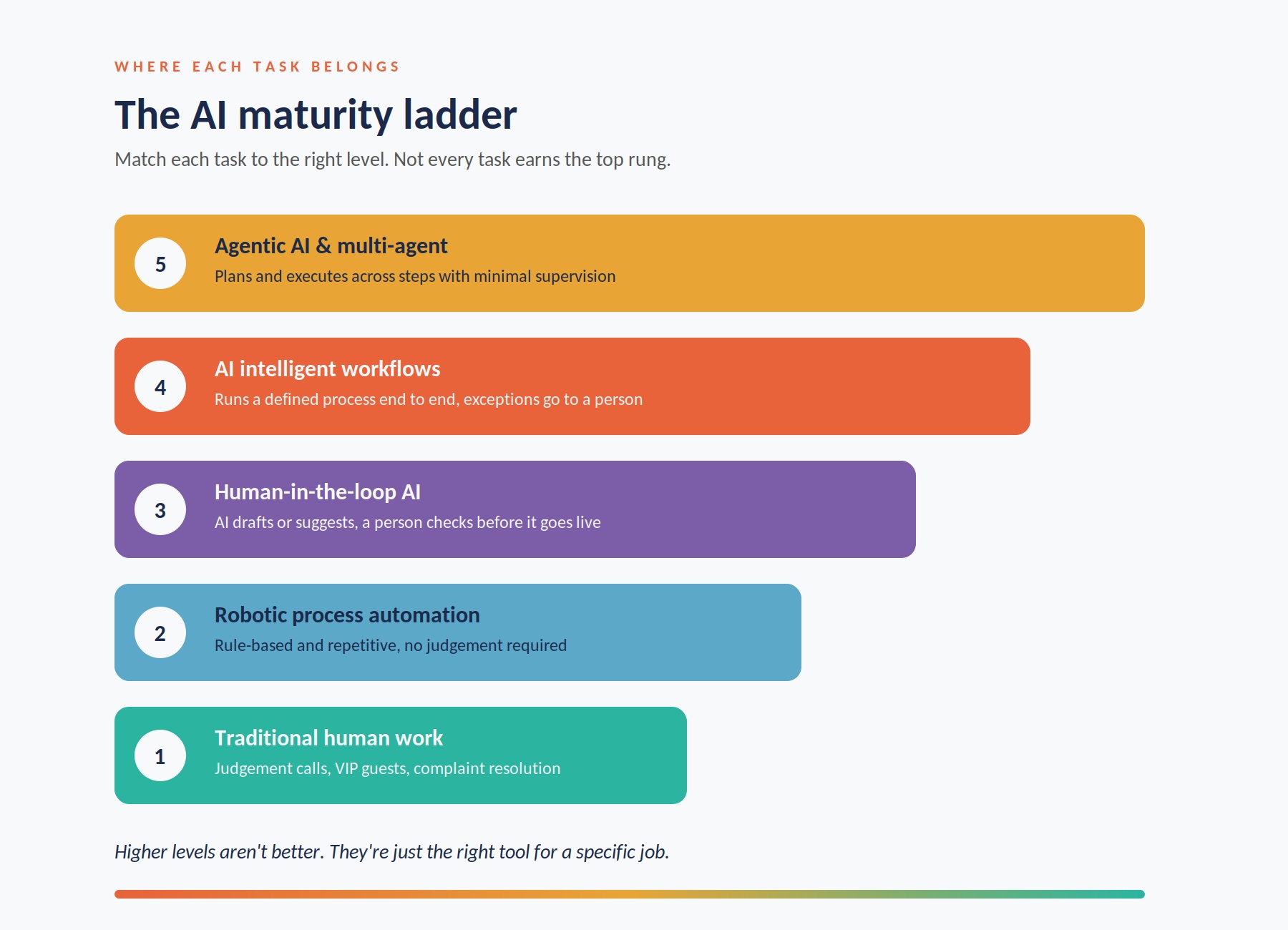
A proper AI strategy sits every task on a maturity ladder and only pushes it up a level when there's a real return for doing so.
Traditional human work – judgement calls, VIP handling, complaint resolution, anything where the guest needs to feel a person made the decision.
Robotic process automation – rule-based, repetitive, no judgement required. Confirmation emails, data entry between systems, standard reporting templates.
Human-in-the-loop AI – the AI drafts, suggests, or first-responds, and a person checks or approves before it goes live. Guest messaging triage, review responses, rota drafting.
AI intelligent workflows – AI runs a defined process end to end within set rules, with exception handling routed to a person. Dynamic pricing within a set band, demand forecasting, and inventory reconciliation across systems.
Agentic AI and multi-agent systems – AI plans and executes across multiple steps and tools with minimal supervision. Genuinely useful for a small number of high-volume, well-defined processes. Expensive and often unnecessary for everything else.
The job of a good consultant is to roadmap which task sits where, then optimise the system around it: what a human should keep doing, which large language models are actually right for the job (they are not interchangeable), what the process looks like end to end, and where the real cost saving is hiding once you stop assuming "more AI" automatically means "cheaper."
What this looks like in practice
Front office. VIP arrivals and complaint handling stay firmly human. Standard booking confirmations and pre-arrival messages run on simple automation, no AI required.
Guest messaging. AI drafts the first response to routine queries (opening times, parking, dietary options) and a team member reviews before it sends, or it sends automatically for the lowest-risk queries only. Anything emotionally loaded gets routed straight to a person.
Revenue management. An intelligent workflow adjusts rates within a band the revenue manager has set, and flags anything outside normal parameters for a human decision rather than letting the system act alone.
Back office reporting. Agentic AI pulls and reconciles data across the PMS, POS and channel manager overnight, so the finance lead reviews a finished report at 9am instead of building one from scratch. The system does the assembly. The person does the interpretation.
Housekeeping and maintenance. Human-in-the-loop dispatch, where AI suggests the most efficient run based on checkouts and requests, and a supervisor confirms it against what they know about the building that the system doesn't.
None of this replaces the team. It removes the parts of their day that were never a good use of a person in the first place, so the parts that need a human get more attention, not less.
Key takeaways
AI pricing was subsidised for years. Reported industry analysis now shows AI running costs for skilled work closing in on the cost of paying a person, not staying comfortably below it.
Firing staff and replacing them wholesale with AI has left some hospitality businesses paying more for a worse outcome.
The strongest model, in chess and in hospitality, is a human and a computer working together, not one replacing the other.
Not every task deserves full automation. Map each one to the right maturity level, from traditional human work through to agentic AI, and only move it up the ladder if there's a genuine return.
Good AI strategy is a design exercise across people, process and systems, not a procurement decision.
Where FAI fits in
This is the work I do; I roadmap which parts of your operation genuinely benefit from AI, which parts should stay human, and which sit somewhere in between, then we build and optimise the system around that answer instead of guessing. If you're seeing any of this in your business, whether that's an AI tool that's quietly costing more than the person it replaced, or a team stretched thin because nothing's been automated at all, it's fixable.
If you want a head start on the "what do we actually need AI for" question, the 100 AI-Powered Prompts for Hospitality Businesses ebook is built around exactly that, prompts sorted by the job they do, not just a long list to wade through.