- Jun 29
THE SMARTEST THING YOU CAN DO WITH AI IN HOSPITALITY IS STOP CALLING IT AI
- Francesca
- 0 comments

Last week a CEO stopped me mid-sentence.
I was on an introductory call with him, the kind where you're trying to make a good impression, and I was doing what I always do: talking about AI. Enthusiastically. Probably too enthusiastically! It is, after all, my favourite topic and I work with it every day.
This week alone I built a research agent that ran through 26 separate HR policy documents, checked them against current UK law, identified exactly what had changed, suggested the new wording, and pinpointed precisely where each policy needed updating. All 26 - in around 10 to 15 minutes. A job that would have taken a human days, done quietly in the background whilst I got on with something else. And it's scheduled to do it again in three months without being asked.
To me, AI isn't a buzzword. It's a colleague.
But this CEO, someone switched on, forward-thinking, running a people-first hotel chain, stopped me and said:
"We've got to stop using the word AI."
It stopped me in my tracks. My first thought was: how on earth do I do my job without mentioning the word AI?
And then I started thinking; and this article is the result.
It's as much for me, figuring out how my own language needs to shift as a consultant, as it is for anyone else trying to move these conversations forward.
The word is broken
I know this from experience, not just from boardroom research.
When I tell people I'm an AI consultant, I watch them switch off. Literally. Mid-conversation. Their eyes glaze, the body language closes, and whatever I say next lands in a room that has already decided this isn't for them.
But when I say "I help hospitality teams cut down admin hours so they can focus on the guest experience," something different happens. People lean in, they ask questions and they tell me about the specific thing in their operation that's been driving them mad for months.
Same person. Same work. Completely different conversation. The only thing that changed was the language.
And that told me everything I needed to know about why AI implementation keeps stalling in hospitality, and what to actually do about it.
What's actually happening in that room
When you walk into a leadership meeting and say the word "AI," you're not just introducing a technology. You're activating a threat response.
In 2024, 28% of employees feared losing their job to AI. By 2026 that figure had jumped to 40%. Your senior team reads the same headlines as everyone else. They've watched Amazon cut corporate roles, Salesforce reduce customer support headcount, and Workday eliminate nearly 9% of its workforce, all with AI cited as the reason.
So when you propose an AI strategy, what lands in that room isn't "operational improvement." What lands is: someone is getting replaced, and it might be someone sitting at this table.
That's the conversation you're walking into before you've shown a single slide.

There's actual science behind why this happens
This isn't just anecdote. There's a well-documented psychological mechanism at work, and understanding it changes how you approach the room.
When the brain perceives a threat, the amygdala fires. It generates an anxiety response to anything uncertain or risky. Neuroscience research shows that the threat-detection system produces a significantly larger signal for a potential loss than the reward circuit does for an equivalent gain. This is loss aversion, and it isn't a rational calculation. It's a hardwired alarm system that prioritises bad news over good.
Behavioural economists Kahneman and Tversky proved this decades ago: people don't evaluate options on their merits. They evaluate them through the frame they're presented in. The same outcome, described as a gain or a loss, produces entirely different decisions. This is the framing effect, and it applies directly to how your leadership team hears the word "AI."
The word is currently loaded with a loss frame. Every headline, every CEO announcement, every redundancy round attributed to automation has conditioned that room to hear "AI" as a threat. Research specifically on AI adoption in organisations confirms it: how AI integration is framed in internal communications directly shapes whether employees resist or engage. The technology hasn't changed. The word has accumulated baggage that is actively working against you.
There's a second mechanism too: status quo bias. The brain actively prefers existing conditions over alternatives, even when those alternatives are objectively better. People stay with what they know unless the perceived benefits clearly and obviously outweigh the perceived risks. Walk in with a two-letter acronym that triggers threat detection and you've made it almost impossible for the benefits to land.
Changing the vocabulary isn't spin. It's strategy.
There's a version of this argument that sounds like you're hiding something. You're not.
The underlying technology doesn't change based on what you call it. What changes is whether the people who need to approve it, fund it, and use it can engage with it without their defences going up first. You're not deceiving anyone. You're leading with the outcome rather than the mechanism, which is what good change management actually looks like.
Most hospitality leaders don't wake up wanting "AI software." They want fewer guest complaints during peak hours, cleaner handovers between shifts and systems that stop lagging when the property is full. Rotas that reflect actual occupancy rather than last month's gut feeling.
Those are the problems. AI is one of the ways you solve them. So the answer is simple; Lead with the problem.
Here's what that looks like in practice. Same technology, reframed conversation:
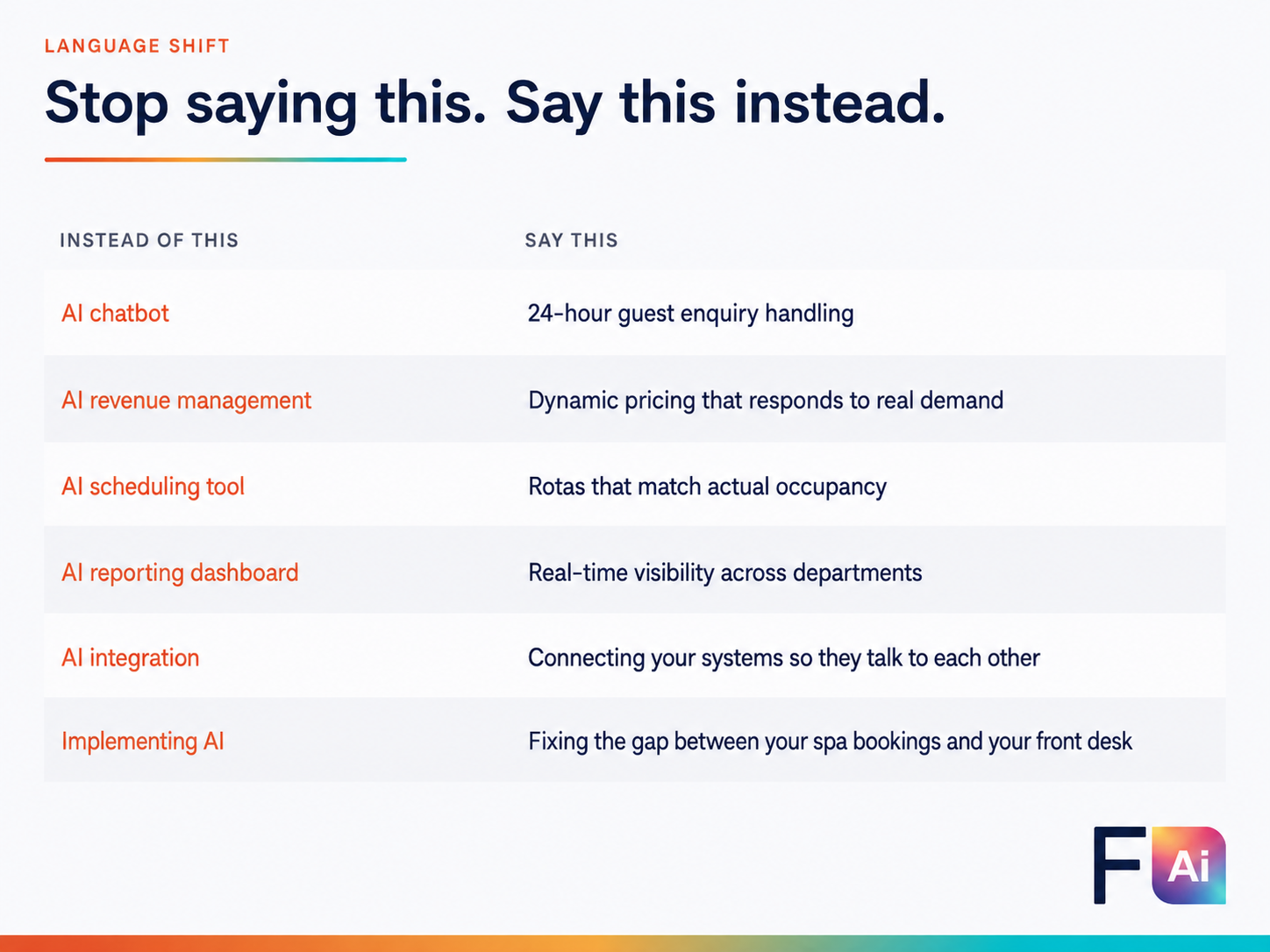
None of those descriptions are inaccurate. All of them are framed as gains rather than threats. And that difference isn't cosmetic. It's the difference between a yes and a no.
What changes when you change the language
A GM who stops saying "we're implementing AI" and starts saying "we're connecting our systems so the spa isn't invisible to reservations" gets a different conversation.
A revenue manager who stops saying "we need an AI pricing tool" and starts saying "we're leaving rate on the table every Thursday night because we're not responding to demand fast enough" gets a different response.
The problem stays the same and the threat disappears.
And once the project is approved, funded, and running, you can call it whatever you want. By that point the team has seen what it actually does. The word has lost its power to frighten because the reality has replaced the headline.
The thing worth being honest about
Some roles in hospitality will change. The coordinator whose entire job is moving information between systems that don't talk to each othe, the analyst manually building the same report every Monday morning and the supervisor whose value comes from knowing things nobody else can access because the data lives in their head. Those roles will look different in five years.
But different doesn't mean gone. What changes is the work itself. The hours spent on manual admin, repetitive reporting, and information chasing get handed to the machine. What's left for your team is the work that actually matters: smarter decisions, more direct impact on the revenue line, and frankly a lot more interesting than reconciling spreadsheets on a Monday morning. Most people, given the choice, would take that trade.
Doing nothing because the word "AI" made the leadership meeting uncomfortable doesn't protect anyone. It just means your competitors make the change while you're still having the same conversation.
The honest framing isn't "AI won't affect your team." It's "here's what we're going to do about it, and here's why doing nothing is the bigger risk." That conversation is much easier to have once you've already got the project approved and the results are visible.

Key takeaways
The word "AI" now carries a loss frame in most leadership environments. It triggers threat detection before the business case gets heard.
Loss aversion and status quo bias are neurological responses, not just cultural ones. Understanding this changes how you frame the conversation.
Lead with the pain point, not the technology. People lean into problems they recognise. They recoil from solutions they don't understand.
Reframe every AI initiative in operational terms: what it fixes, not what it's called.
Changing the vocabulary isn't dishonest. It's meeting people where they are, which is what change management actually requires.
Once results are visible, the word stops mattering. Get to results first.
This article started because a CEO corrected my language mid-call. It's made me rethink how I show up in every conversation I have as a consultant. If you're a leader trying to move these projects forward inside your organisation, I hope it does the same for you.
The goal isn't to talk about AI. The goal is to solve the problem in the room. Start there.
FAI Consultancy works with hospitality businesses to make AI implementation practical, commercially grounded, and something your team can actually get behind.