- Jun 8
Your Spa System Doesn't Know Your Guest Checked In
- Francesca
- 0 comments

Your guest checked in two hours ago, they booked a spa treatment for tomorrow morning and they asked about the golf tee times at dinner last night. They've stayed with you three times and spent more on food and beverage than the room rate on every visit.
Your front desk doesn't know any of that, neither does your spa, the restaurant, or the golf pro.
Because none of your systems talk to each other.
This is the fragmented hotel systems problem. And it is quietly costing the industry billions.
The Real Operational Problem With Disconnected Hotel Systems
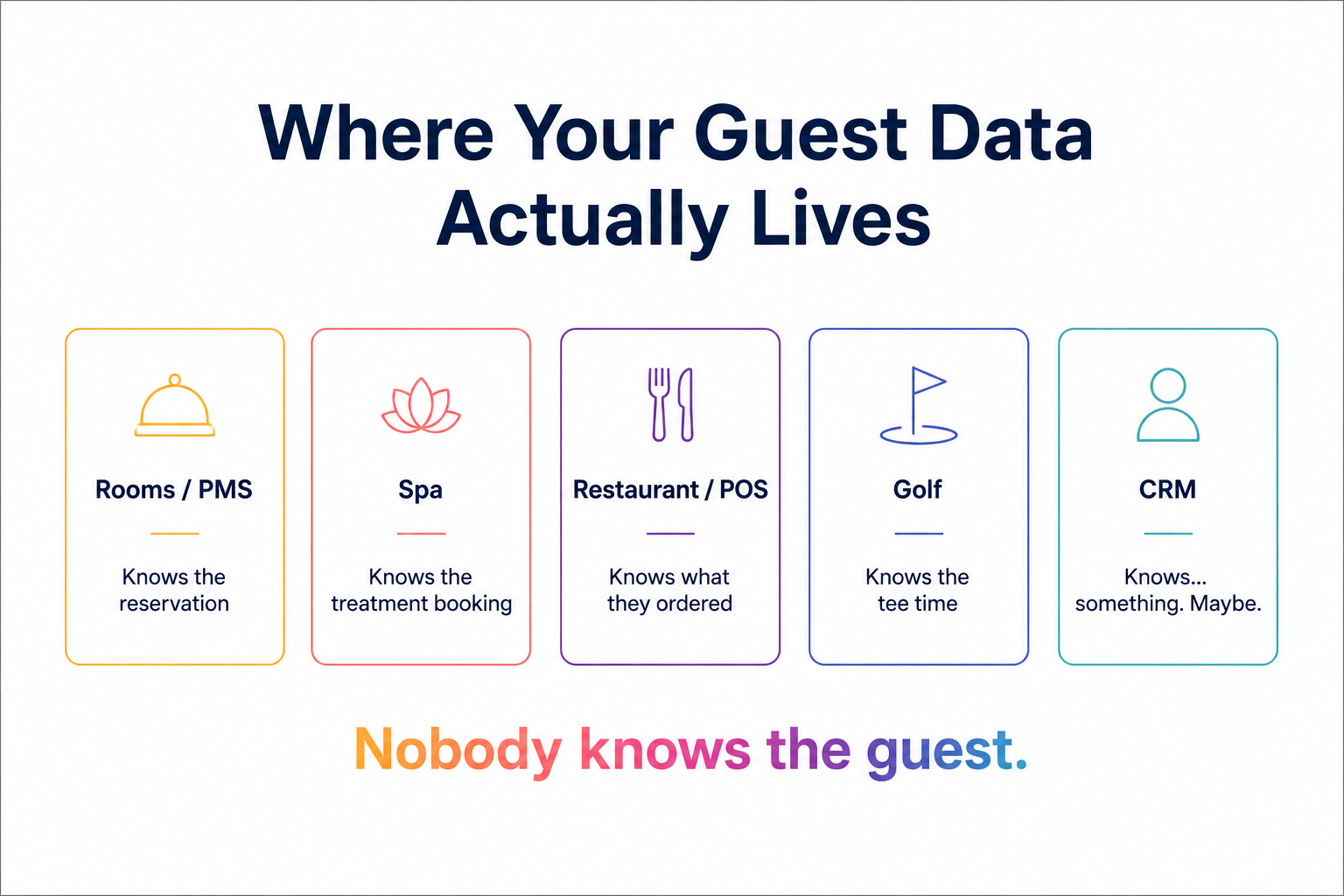
Walk into most hotels and resorts and you'll find a familiar setup: a Property Management System handling reservations and rooms. A separate POS for food and beverage. A spa booking platform that lives in its own world. A tee time system for golf. Maybe a health club access tool. A channel manager and a CRM that someone set up two years ago and nobody quite trusts.
Each system was bought to solve a specific problem. Each does its job well enough in isolation. But together, they don't work; they just coexist.
The result is data silos: isolated pockets of guest information that never combine into anything useful. When a guest calls to modify their stay, that update goes into one system. When they book a massage, that's a second system. When they eat at the restaurant, a third. And when they check out, nobody has a complete picture of who they were, what they valued, or how to bring them back.
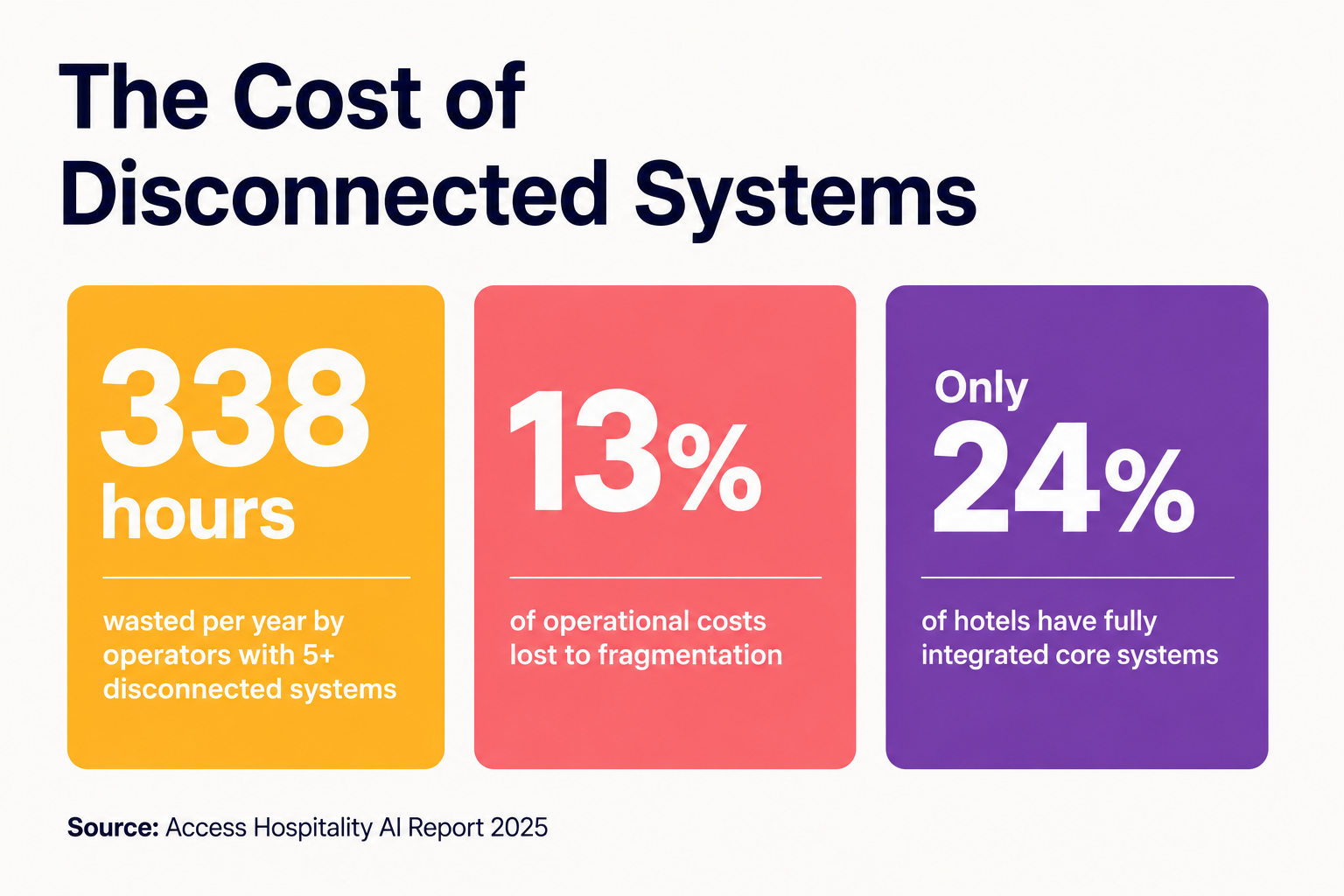
According to the Access Hospitality AI Report 2025, which surveyed 1,000 hospitality businesses, operators with five or more disconnected systems waste 338 hours a year manually switching between them. That's the equivalent of nearly nine working weeks spent on a problem that should have been solved by software.

Why It Keeps Happening
No one set out to build a fragmented tech stack, it happened incrementally. A new spa opened, so you bought a spa system. Golf was added, so you found a tee sheet tool. The restaurant needed a decent POS, and the existing one didn't cut it. At each decision point, the choice made sense in isolation.
The problem is that hospitality technology has historically been built in vertical silos. Spa vendors built spa software, golf vendors built golf software, and PMS vendors built PMS software. Integration between them was an afterthought, typically handled by expensive custom connectors. APIs that frequently broke on updates, or more often, a member of staff manually transferring data between screens.
A 2025 industry study found that only 24% of hotels report full integration across their core systems. Just 34% manage guest data centrally and sixteen percent still rely on manual methods entirely.
That is not a staffing problem. It is a systems problem that has been normalised for so long it's become invisible.
The Reframe: Your Staff Are the Integration Layer
Here is the thing most operators don't say out loud: when systems don't connect, your people become the connectors.
The front desk manager who checks the spa diary before briefing the team, the restaurant supervisor who phones housekeeping to confirm late checkouts before seating dinner and the GM who pulls three different reports and reconciles them in a spreadsheet on a Friday afternoon to get a picture of the week.
Every one of those moments is a person doing a job that software should be doing. And while they're doing it, they are not serving guests, developing the team, or making commercial decisions.
Infor described this well: when systems don't share a consistent operational truth, humans become the necessary integration layer. That is not operational excellence. That is a tax the industry has been paying for so long it's forgotten it's paying it.
And then you add AI on top; which brings us to the uncomfortable part.
Why AI Makes the Problem Visible (and Can Fix It)
Most hotels that try AI first hit a wall. Not because AI doesn't work, but because it has nothing reliable to work with.
Sixty percent of hospitality businesses say the data from their current systems is incomplete or unreliable. Fifty percent say it's hard to trace where data comes from or how it's calculated. You cannot build useful intelligence on top of that. If anything, adding AI tools to a fragmented stack accelerates the problem: more systems, more connectors that break, more duplicate guest records, more discrepancies to reconcile. The industry has started calling this "integration debt." Every new tool gets harder to add than the last.
Here's the honest diagnosis: Most hotels don't have an AI problem first; they have a systems problem.
But here's where it gets interesting. When the foundation is right, AI does not just automate tasks. It sees across the entire property in a way no human team ever could, and it acts on what it sees.
So How Do You Actually Fix It?
This is where most articles tell you to buy a new enterprise platform. That is not always the right answer, and for most independent hotels, boutique properties, and smaller resorts, it is usually the wrong one.
The fix depends on what you're already running. Here are the four routes, in order of complexity and cost.
Route 1: Check your PMS marketplace first.
This is the question most operators never think to ask. If you're on a modern cloud-based PMS such as Mews, Cloudbeds, or Apaleo, your spa or restaurant system may already have a one-click integration available. Mews alone offers over 1,000 integrations. Cloudbeds has 400-plus. Apaleo is built specifically to let independent hotels connect best-of-breed tools without being locked into a single vendor's ecosystem.
The starting point is not a technology project. It is logging into your PMS marketplace and spending twenty minutes checking what is already there.
Route 2: No-code automation as a bridge.
If your systems do not have native connectors, tools like Make.com and Zapier can link them without a developer and without touching the underlying software. In practice, this means: when a guest checks in via your PMS, a workflow automatically pushes their name, room number, and arrival details to your spa system, restaurant, and activity booking tool. It is not a perfect unified data layer, but it closes the most visible gap immediately.
Make.com is already used by hotel groups to automate reservation data, guest communications, and cross-department updates. The cost is a fraction of a custom integration, and the setup for a straightforward workflow can be measured in hours, not months.
The catch: this only works if your PMS has an open API. Legacy on-premise systems often do not, which means no-code tools cannot reach them. If that is your situation, see Route 4.
Route 3: A data hub layer.
For properties that want proper cross-system integration without replacing their PMS, Hapi is worth knowing about. It is a cloud data hub that sits above your existing hotel systems, connects to multiple PMS platforms simultaneously, and normalises all the data into one common model. Spa, POS, CRM, and activity systems can then read from and write to a single data stream rather than operating in isolation.
Hapi currently serves over 6,500 hotels including IHG, Hyatt, and Accor. It is more enterprise-leaning in its typical client base, but the model is the right one: a layer that sits above what you already have rather than replacing it.
Route 4: Switch your PMS to an API-first platform.
If your PMS is old, on-premise, and closed to external connections, working around it will always be a compromise. The longer-term fix is a PMS switch. Modern cloud platforms designed for independent operators, including Mews, Cloudbeds, Little Hotelier, and Apaleo, typically cost between £150 and £300 per month, can be set up in one to two weeks, and are built from the ground up to connect with the tools around them.
That is not a massive investment. For most independent properties, it would pay for itself within weeks if it unlocks even a fraction of the ancillary revenue currently being missed.
For large resorts with golf, spa, F&B, and membership at scale, platforms like Agilysys are built for exactly this complexity. Their guestsense.ai framework unifies PMS, spa, golf, dining, activities, and membership into a single intelligent guest profile. The investment is significant, but so is the operational scope it is designed to serve.
The pattern across all four routes is the same: the goal is a shared data layer, not more systems. How you get there depends on what you are starting from.
What AI Actually Does When Systems Are Connected
When your PMS, spa, dining, golf, and activity booking platforms share a unified data layer, AI can do things that are genuinely valuable to the bottom line.
It builds a real guest profile. Not just a name and a room preference. A full picture of who spends on what, when, and why. The guest who always books a couple's treatment on day two. The solo business traveller who orders room service on Sunday evening and has never been offered a wellness package and the family who spends heavily on kids' activities but never touches the restaurant.
It triggers the right offer at the right moment. A guest books a room. AI then checks their profile, sees three previous stays with spa spend on each, and automatically sends a pre-arrival email with a spa package at a price calibrated to their history. If they accept, the upsell campaign pauses and a dining offer goes out instead. No human coordination required.
It fills gaps your team will never see. AI can detect demand shifts across venues in real time and adjust offers accordingly. Spa slots that would otherwise sit empty in the afternoon get targeted at the right guest before they have even asked. That is revenue management across multiple departments without a revenue meeting.
It gives management actual visibility. A unified data layer means your GM can see margin performance across rooms, F&B, spa, and golf in one place. Not three reports printed and stapled together. Not a Friday afternoon reconciliation exercise. A live picture of where the property is making and losing money.

What This Looks Like in Practice
A hotel group implementing AI-powered upselling across connected systems reported the following within three months: pre-arrival email open rates increased from 28% to 47%, room upgrade conversion grew from 4.2% to 16.8%, ancillary revenue per occupied room increased by £28, and total additional annual revenue across the group reached £380,000.
That is not from adding more staff. It is from connecting the data that already existed and letting AI act on it systematically.
The pattern is consistent; when systems share data, AI can work. When they don't, it can't.
Key Takeaways
Most hotels and resorts run multiple disconnected systems for rooms, spa, golf, dining, and activities. These systems were not designed to share data.
The result is staff manually bridging gaps, incomplete guest profiles, and missed revenue across every ancillary category.
Operators with five or more disconnected systems waste 338 hours a year switching between them, with 13% of operational costs lost to fragmentation.
Adding AI to a fragmented tech stack does not fix the problem. It usually makes it more expensive.
The fix is not always a new enterprise platform. Start by checking your PMS marketplace, then consider no-code automation, a data hub layer, or a PMS switch depending on what you are running.
For large resorts managing golf, spa, F&B, and membership at scale, purpose-built platforms like Agilysys are designed for exactly that complexity.
When the data layer is unified, AI can build real guest profiles, trigger personalised cross-venue offers, and give leadership a clear commercial picture across the whole property.
The starting point is not buying new systems. It is understanding what you have and what it can connect to.
If You're Seeing This in Your Business, It's Fixable
The fragmented systems problem is not unique to your property. It is the default state of the industry. What matters is whether you treat it as a background irritation or a commercial problem worth solving.
If your team is manually bridging gaps between systems, if your spa doesn't know who just checked in, if your GM is reconciling reports on a Friday afternoon rather than making decisions, the data you need to run a smarter operation already exists. It's just trapped.
An AI Assessment followed by the Transformation Blueprint from FAI Consultancy maps your current systems, identifies where data is siloed, and builds a practical integration roadmap that gives AI something real to work with. No theory, no generic tech stack recommendations. Just a clear picture of what you have, what it's costing you, and what to do about it.
Book a 15-minute intro call to find out what it would look like for your business.